
A cautionary tale for brand owners: Adidas v Thom Browne and the position on ‘Position Marks’


In our increasingly visually dominated world, where brand identity is as much about design language as it about logos or names, the placement of a brand's mark can be just as distinctive as the mark itself. These so-called 'position marks', trade marks that protect the specific placement of a sign, colour, or design element on a product, offer a way for brands to safeguard what can often be powerful visual cues in their identity. However, as the Court of Appeal's recent decision in Adidas v Thom Browne shows, securing and enforcing such protection is far from straightforward.
In this article, we explore what position marks are, why they are so challenging to register and enforce, and the lessons the Adidas case offers for brand owners looking to build their identity in a design-driven marketplace.
Understanding position marks
Traditional trade marks protect symbols such as names, logos and figurative signs that help consumers distinguish one trader's goods or services from those of another. But as brands become more design-led, that distinctiveness can lie just as much in what appears on a product as it does on where it appears. This is where position marks come in.
A position mark (a type of "non-traditional" trade mark) protects the specific placement of a sign, colour or design element on a product. You most likely recognise the signature red tab on the back pocket of Levi's jeans or perhaps the three stripes along the side of an adidas trainer. These elements (or marks) aren't simply decorative; they communicate brand identity through their particular placement on a product.
Unlike traditional trade marks, which protect a sign irrespective of its placement relative to a product, position marks protect the combination of a design element and its placement (or 'position'). In other words, a position mark is composed of two elements:
- the mark itself; and
- its precise position on the product.
The challenges of registering and enforcing position marks
To be accepted for registration, a position mark must, like any other trade mark, meet the basic requirements of being distinctive and capable of indicating origin. That might sound straightforward enough in practice; however, those standards are much harder to satisfy when trying to protect what can be a nebulous concept like placement.
The first challenge is one of precision. A position mark must precisely define where the sign appears on the product, along with its size and proportion in relation to the goods. The written description and visual representation of the application must align perfectly; any ambiguity – for example, flexible wording in a description or lack of clarity in an illustration – can render the mark invalid. Here, we have an example of a valid position mark filed by adidas at the UKIPO for its three stripes on footwear:
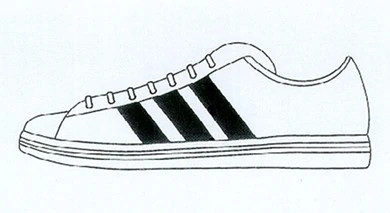
The corresponding description refers to "three parallel equally spaced stripes applied to footwear, the stripes positioned on the footwear upper in the area between the laces and the sole". The illustration and description work together to provide a sufficiently clear and precise indication of the stripes’ position, including their start and end point.
The second challenge is one of distinctiveness. Consumers don't usually perceive the shape or placement of a design element as a brand indicator. For a position mark to work as a trade mark, the average consumer must recognise the placement of the element itself as a badge of origin, which means the mark must be inherently distinctive or have acquired distinctiveness through significant and consistent use.
Even if registered, there can be a challenge of enforcement because protection depends on the precise positioning indicated in the registration, any variation in use can weaken a claim. To be successful, brand owners must be able to show that the mark has been applied consistently on the product and that consumers have come to associate its placement with their brand over time.
The Adidas v Thom Browne decision
These challenges were recently the focus of a Court of Appeal decision that upheld the invalidity of a number of Adidas’s three-stripe position marks as their representation on the register was too broad and covered multiple signs.
Fashion brand Thom Browne sought cancellation or revocation of several Adidas marks through the High Court, arguing Adidas was claiming an overly broad monopoly across numerous stripe variations. Adidas rejected this and counterclaimed, alleging that Thom Browne’s use of a four-stripe design on garments and other products created a risk of confusion and took unfair advantage of the distinctiveness and reputation of Adidas’s marks. The High Court found eight of Adidas’s marks invalid for lacking the requisite clarity and precision. Adidas appealed in respect of six of the eight invalidated marks. However, in October 2025, the Court of Appeal upheld the High Court’s decision.
The issue at hand was not whether Adidas's three stripes were iconic, few would dispute that they are, rather the issue was whether the marks were described sufficiently clearly as to what exactly Adidas were seeking to protect. The marks under dispute were described in Adidas's filings as consisting of "three parallel, equally spaced stripes applied to a garment…running along one third or more of the side of the garment." Examples of these are set out below
The Court found that the written descriptions and pictorial representations in the filings did not identify a single, specific sign but rather a range or multiplicity of variable stripe placements and lengths. These variations, particularly the unspecified length and starting points of the stripes, meant that the marks were not sufficiently clear and precise and risked creating an unfair competitive advantage by effectively granting adidas a broad monopoly over a concept (three stripes on a garment) rather than a specific sign.
Lessons for brand owners
The Adidas decision should serve as a cautionary tale for any brand owner navigating the world of position marks. Non-traditional marks such as position marks are inherently more vulnerable to challenge than traditional trade marks and infringement will turn on how consumers actually perceive the marks, irrespective of how famous the brand may be. The two key points are:
- Position marks must be defined with clarity, both in their written description and pictorial depictions; any ambiguity in the mark's boundaries (its placement, size, or proportion) can undermine its validity. Reputation alone will not compensate for a vague or imprecise registration.
- The mark must be distinct. Even long use won't be enough to save a mark that consumers aren’t able to distinguish from the normal appearance of the product and view as an indicator of origin.
Conclusion - earning your stripes
As design language becomes more visual, non-traditional trade marks like position marks play an increasingly important role in brand strategy, ensuring that a brand's unique product features are safeguarded against imitation. However, as powerful as these brand assets can be, they must be clearly defined, consistently used, and understood by consumers as distinctive indicators of origin. This is a high bar, and a great deal of care needs to be taken at the application stage to protect these signs and your business from challenges. Careful thought must be given to ensure the registration defines a single sign which is sufficiently clear and precise. Verbal descriptions in particular need to be carefully considered as open-ended wording such as "one third or more" or "substantially the whole" are likely to be considered as unclear.
Get in touch






Principal Director - Chartered Trade Mark Attorney
Intellectual Property | Charities









Related





Articles