Could solar carports be the next renewable opportunity for UK businesses?

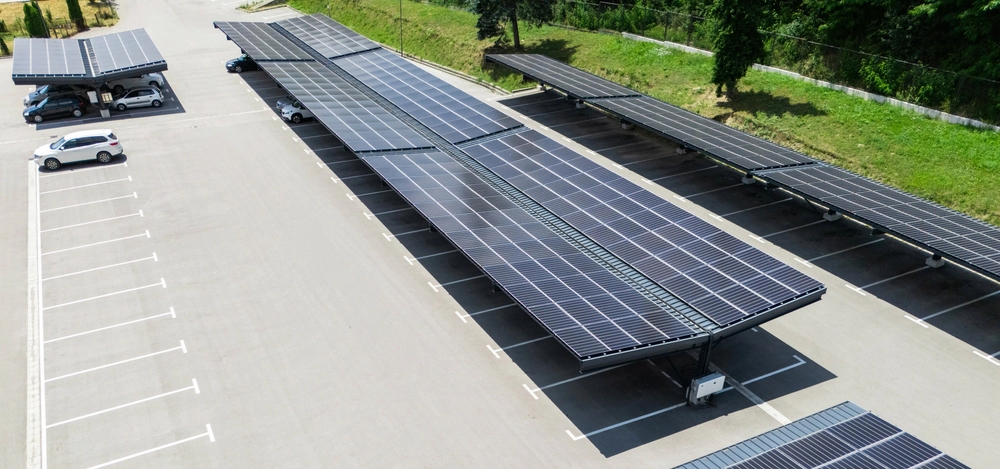
For many retailers, logistics operators and other businesses, the drive towards decarbonisation often focuses on rooftop solar, electric vehicle (EV) charging installations and energy efficiency measures. An increasingly prominent, but often overlooked, option (both as an alternative or complementary measure) is the solar carport.
Recent planning reforms and growing pressure to maximise renewable generation on already developed land mean that solar carports are likely to remain firmly on the agenda for both policymakers and businesses. This article explores what solar carports are, what UK law currently provides for, and the opportunities and challenges they may present to interested parties.
What are solar carports and what can we learn from the French model?
A solar carport (sometimes referred to as a solar canopy) is a freestanding overhead structure fitted with photovoltaic (PV) panels and installed above car parking spaces. In practical terms, it transforms a conventional car park into a source of renewable electricity, whilst providing weather protection for the vehicles beneath. Electricity generated by the solar panels can be used directly on-site, stored in batteries, utilised for EV charging and/or be exported to the grid.
The concept gained considerable attention in France when the government introduced legislation mandating that certain outdoor car parks exceeding 1,500 square metres were required to provide solar-covered shading across at least 50% of the relevant parking area (subject to a range of exemptions such as environmental and heritage site constraints). Implementation was phased according to car park size, with larger sites facing earlier compliance deadlines.
France has already demonstrated the potential scale of such projects. Disneyland Paris completed a 36.1 MWp solar canopy installation covering approximately 11,200 parking spaces. The project generates around 36 GWh of carbon-free electricity annually and is reported to supply approximately 17% of the resort's total electricity consumption.
The French approach reflects a broader policy objective: to increase renewable energy generation without utilising additional greenfield land. By utilising already developed surfaces, solar carports deliver renewable power while preserving agricultural and environmentally sensitive land for other purposes.
What is the legal position in the UK?
The UK Government considered, but ultimately declined, introducing a French-style mandate. In 2025, the Department for Energy Security and Net Zero sought evidence on whether solar canopies should be required for new outdoor car parks. Although solar carports remained part of the wider Solar Roadmap discussions, the Government announced in May 2026 that it would not pursue a mandatory approach "at this point".
However, the planning framework has become increasingly supportive of solar carport development. Certain solar canopies located above lawful non-domestic off-street parking areas may benefit from permitted development rights under the Town and Country Planning (General Permitted Development) Order 2015 (GPDO), subject to certain building conditions, limitations and, in some cases, prior approval requirements.
Businesses considering an installation should nevertheless undertake careful project-specific analysis. For example, under current rules, solar canopies cannot exceed four metres in height and must not be located within ten metres of residential properties.
Solar carports in practice: opportunities and challenges
The business case
For energy-intensive retail, leisure and industrial sites which operate large car parks, solar carports can offer a number of benefits:
- They enable businesses to generate renewable electricity using existing developed land. This can be particularly valuable where rooftop space is limited or not suitable for an installation, or where additional generating capacity is required beyond what roof-mounted solar can provide.
- The electricity generated can often be consumed directly on site, reducing exposure to volatile wholesale electricity prices.
- Solar carports can complement a business' decarbonisation objectives. They can be integrated with EV charging infrastructure and battery energy storage systems, helping businesses support fleet electrification while improving energy resilience.
At a national level, the opportunity is significant. Estimates from Mark Barrett, Professor of Energy and Environmental Systems Modelling at University College London, and Catapult Energy Systems suggest UK car parks could accommodate between 11 GW and 26 GW of solar capacity, representing a meaningful contribution towards the Government's net-zero targets.
The challenges
- The most obvious barrier to an uptake of solar carports is cost. Unlike a rooftop solar installation, a solar carport requires substantial structural works. In many cases, the canopy infrastructure represents a significant proportion of the project's expenditure.
- There are practical and legal considerations that vary considerably from site to site. Grid capacity constraints, drainage requirements, traffic management and land ownership arrangements can all affect project viability and timelines.
For these reasons, policymakers have so far resisted imposing blanket obligations. Whilst a mandate would promote market standardisation, it inevitably creates questions around exemptions, economic viability and implementation for sites where development is impractical.
Final thoughts
Solar carports sit at the intersection of several major trends shaping the UK energy landscape: increasing electricity demand, decarbonisation commitments, EV adoption and the need to maximise renewable generation without increasing pressure on greenfield land.
Although the UK has stopped short from introducing a French-style mandate, it has already lowered planning barriers and signalled continued interest in the technology. For retailers, leisure operators, manufacturers, logistics businesses and other organisations with significant parking infrastructure, solar carports represent an opportunity to reduce energy costs, support sustainability objectives and derive greater value from existing assets.
Whether widespread deployment ultimately arrives through regulation, incentives or purely commercial drivers remains to be seen. What appears increasingly clear, however, is that the debate is no longer about whether solar carports work. The question is where, and on what terms, they make commercial sense.
Get in touch

Managing Associate
Energy & Infrastructure | Projects, Infrastructure & Construction
Bristol